

EuroHockey’s Organisational Health service is gaining strong momentum as national associations across Europe make use of its structured approach to improving governance, strategic planning, and long‑term sustainability.
The structured five‑step framework has enabled national associations to better understand their organisational needs, align with government and Olympic bodies, and build sustainable pathways for growth. Its early success has created strong momentum, with increasing demand from members seeking to benefit from a consistent, insight‑driven approach to developing their strategic futures.
Completed Nations
The Organisational Health service has been fully completed in:
- Bulgaria (BUL)
- Croatia (CRO)
- Finland (FIN)
- Portugal (POR)
- Türkiye (TUR)
Each of these national associations has progressed through the full cycle, from readiness assessment through to strategic launches and the first year of implementation, resulting in stronger operational resilience and clearer strategic pathways.
Nations Currently in Progress
EuroHockey is actively working with the following national associations as they progress through the Organisational Health steps:
- Ireland (IRL)
- Malta (MLT)
- Hungary (HUN)
- Ukraine (UKR)
These nations are currently moving through Steps 1–3, undertaking self‑assessment, deep‑dive mapping, and alignment meetings with the appropriate national sports bodies to prepare for new long‑term strategies.
Project updates
Malta – Strategic Structures Strengthened, Strategy Nearing Late‑Spring Release
Malta has made clear forward progress toward stronger organisational health by completing a comprehensive three‑day strategic planning process involving clubs, national institutions, and key sport governance bodies.
The work included structured engagement with the Maltese Olympic Committee, SportMalta, AIMS, and all major hockey clubs (pictured above). This culminated in a consolidated next‑steps plan focused on long‑term development and better‑aligned structures, laying the groundwork for the country’s new national hockey strategy.
By the end of the meetings, Malta had established unified direction and improved collaboration among clubs and institutions, setting them on track for a late‑spring release of their refreshed strategy.
Hungary – Feasibility Studies and Governance Support, Strategy Expected Spring/Summer
Hungary’s project has moved decisively forward through high‑level coordination between EuroHockey, the Hungarian Olympic Committee, and the Ministry of Defence.
Central to progress is the feasibility study for two new hockey pitches, scheduled for completion in late May, a major infrastructure step for a country lacking official pitches.
The broader organisational health work includes Hungary’s participation in the Erasmus+ “Solidarity through Great Governance”programme, which supports the development and implementation of their new national strategy.
Hungary’s new strategy is due in November 2025, but ongoing consultancy and feasibility planning place the country in a strong position to communicate its strategic direction in late spring, in line with your summary request.
Ireland – Deep Stakeholder Engagement, Strategy Coming in 2026
Ireland has significantly advanced its organisational health project with EuroHockey by delivering a two‑day series of high‑level strategic development meetings.
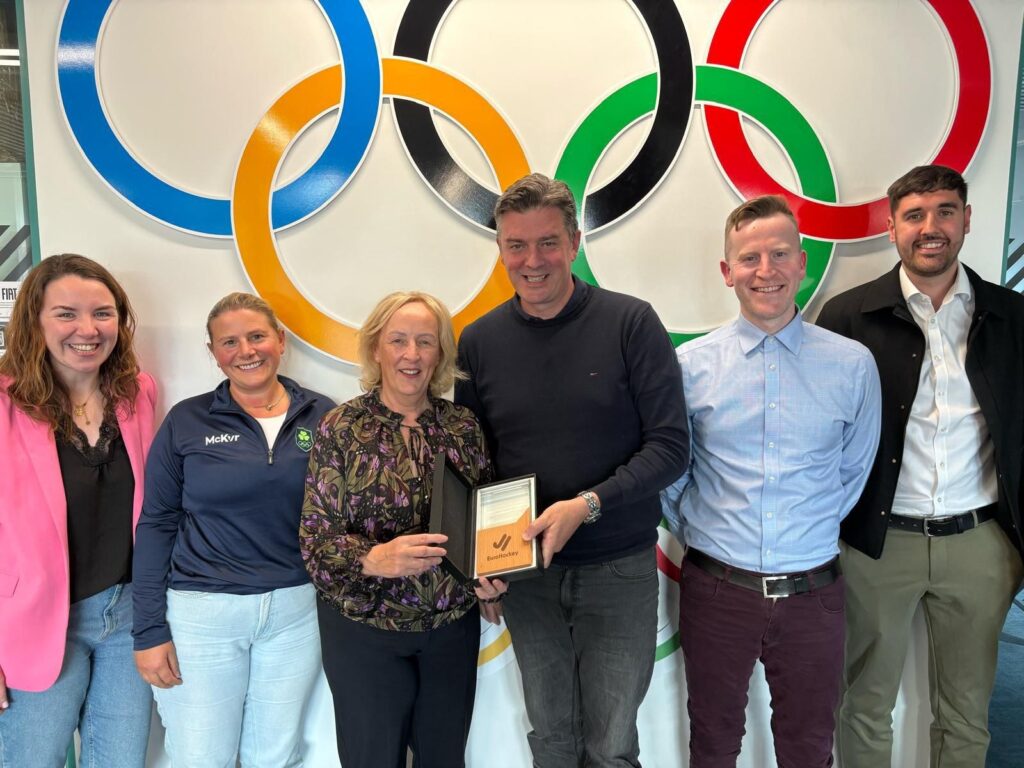
Visiting Hockey Ireland last September
These brought together senior leadership from Hockey Ireland, provincial bodies, Sport Ireland, Sport NI, the Olympic Federation of Ireland, Special Olympics Ireland, and others, following this there has been a series of provincial level meetings with representatives of the province leadership teams and boards, with a report delivered to the Hockey Ireland Board and new CEO.
The focus was on reviewing structures, aligning national and provincial governance, and identifying areas for operational strengthening. This collaborative work represents an early but important phase in Ireland’s next strategy cycle.
Given the depth of consultation required, including extensive community and stakeholder engagement, the country’s new national strategy is expected later in 2026.