

Siobhán Madeley celebrates 30-years working with EuroHockey this week, 30-years as a cornerstone of the promotion of the sport in the continent, 30-years of evolution and professionalisation.
When she walked into the newly formed EHF office in Dublin in November 1995, she could hardly have imagined the scale of change—technological, organisational, and cultural—that would unfold around her over the next three decades.
Nor could she have foreseen the role she herself would play in shaping that evolution. From a one-woman administrative operation working with fax machines and hand-written appointment letters to leading EuroHockey’s communications strategy through the digital age, her career follows closely the federation’s growth itself to nine full-time staff currently.
** Siobhán Madeley, pictured above, at the 2019 EuroHockey Championship press launch in Belgium
“It made more sense for the office of the European Federation to be with the secretariat… in Dublin,” she recalls, describing how Secretary General David Balbirnie invited her to help set up the new administrative base.
It followed the success of the 1995 Europeans in Dublin, where she was working for the Irish Men’s Hockey Association and opened the door to be the first formal full time member of EHF staff.
At that point, European hockey was a very different world. “We had no internet … we certainly didn’t have email. We communicated by fax!” she says.
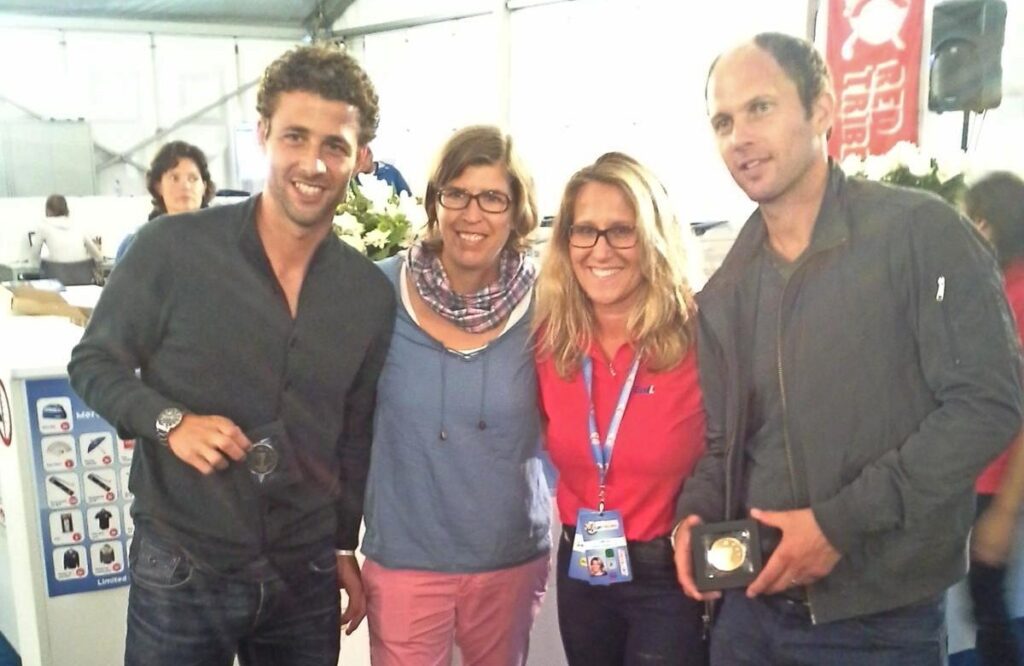
** With Santi Freixa, Natascha Keller and Teun de Nooijer at the 2011 EuroHockey Hall of Fame announcement
It relied heavily on a network of highly attuned volunteer experts such as Martin Gotheridge (regulations), Martyn Gallivan (outdoor competitions), Martin Campbell (indoor) and Marianne Kooijman (officials appointments).
“We couldn’t have done what we did without them,” she emphasises.
Her early administrative tasks bordered on the monumental. Appointment letters, for example, had to be physically laid out across the entire office floor so each person could receive their individual assignments by post.
“You got your letter… the assumption was you would accept,” she recalls with a laugh. Anyone declining had to “phone Marianne”—a daunting prospect that ensured very few refusals.
A Career Shaped by Change
From that manual starting point, a recurring theme has defines Siobhán’s 30 years with EuroHockey, it is change—constant, often dramatic, always embraced.
“We talk about our current digital transformation… but I think we’ve actually been in change as an organisation since the very start,” she reflects. “My role kept changing all the time.”
Indeed, an early turning point came with the creation of the first EuroHockey website, working with Gianni Rossi and his wife Carla Cotelli. It was a significant step toward the world of online communication—one that would soon become her central role.
The move of the EHF offices from Dublin to Brussels marked another pivotal moment. Siobhán was offered the chance to continue as administration manager if she relocated, or to pivot into marketing and communications while remaining in Ireland.
As a single mother, the choice was clear: “We chose as a family to stay in Dublin,” she explains. The federation backed the decision, allowing her to become “a remote worker before it was trendy”.
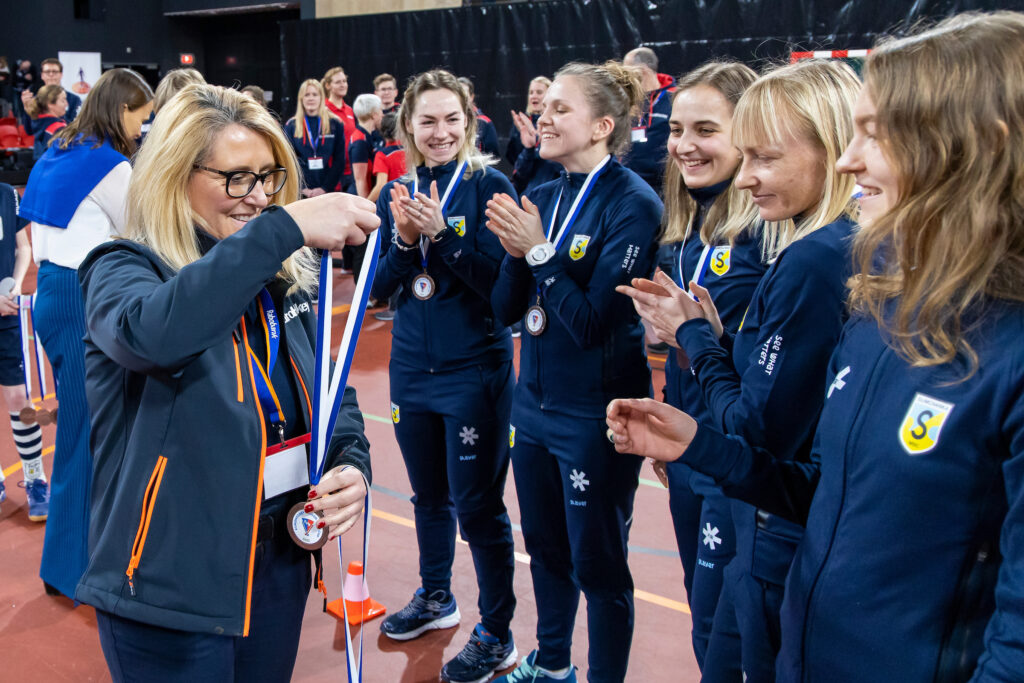
** Presenting medals to MSC Sumchanka at the 2020 EuroHockey Indoor Cup Cup in the Hague. Picture: Willem Vernes/World Sport Pics
Recognising the need to strengthen her voice in strategic discussions, she returned to education, qualifying from Dublin Business School: “I studied digital marketing because I needed to feel confident in my decision-making and presenting strategies to the Board and more importantly to ensure I was using the right tools to showcase our sport.”
That step helped formalise her shift from marketing to communications manager in 2011, reflecting a role increasingly focused on storytelling, messaging, and EuroHockey’s growing digital presence.
Modernising Community and Competition
One of her most significant innovations was the overhaul of the press conference model at major tournaments.
“In 2012,we instigated change from press conferences post-game to mixed zone and iZone,” she says. The aim was simple: better access, more authenticity, and a more holistic approach benefiting athletes and journalists alike. It transformed the rhythm and openness of media interactions around EuroHockey events.
She also helped, under the leadership of Angus Kirkland, usher in EuroHockey’s streaming era, partnering with Sportradar in 2017 to launch the federation’s streaming platform and ensuring that European hockey reached fans around the world.
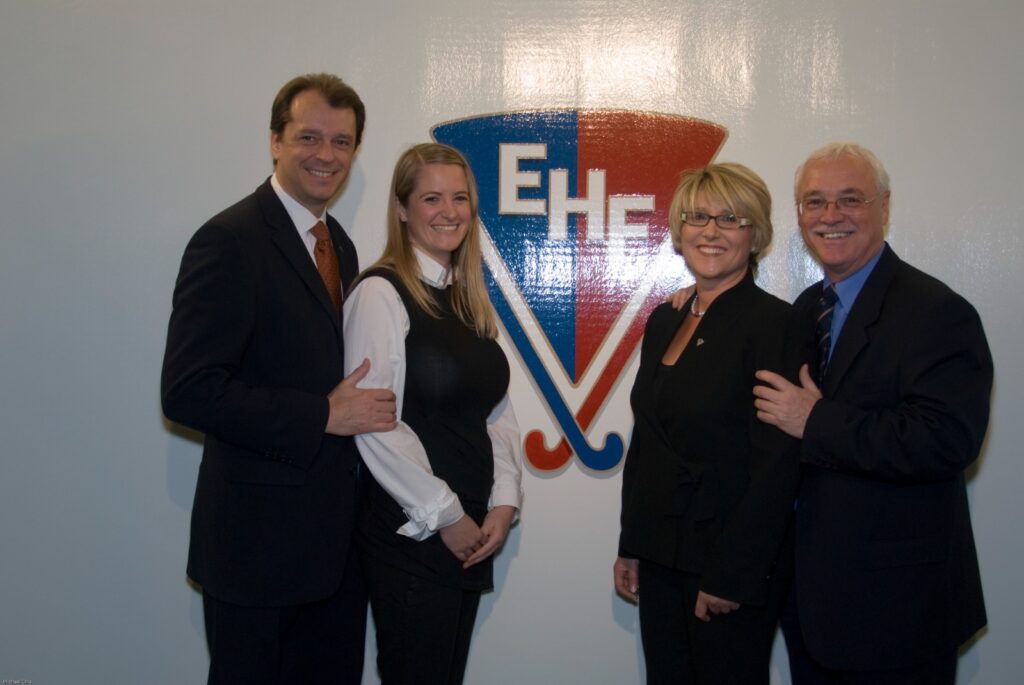
** With new colleagues Steve Catton, Jane Brennan and Norman Hughes as EuroHockey’s staff began to grow
The growth of EuroHockey’s social channels—now an integral part of its brand identity—was another milestone she helped drive, always with an eye on serving both players and fans.
Her behind-the-scenes contribution to the sport’s presentation is equally notable. Few realise, for example, that she designed the walk-out and handshake protocol now standard at EuroHockey events—a small detail that helped elevate the professionalism of matchday operations.
Witness to hockey history
Siobhán’s tenure placed her at the heart of pivotal moments for the sport in Europe. In the aftermath of the USSR’s dissolution, she witnessed—and supported—the enormous volunteer-led effort to keep the newly independent nations involved in hockey.
“It was really important to keep the new republics playing,” she says of the period. Board members travelled extensively to maintain unity and participation during a time of upheaval.
She remembers unusual board meeting locations, including a trip to Azerbaijan “with armed guards,” and unforgettable personal milestones, such as spending her youngest son Luke’s first birthday at the opera in St Petersburg during a EuroHockey Board meeting.
“A personal highlight was watching Belgium men qualify for their first Olympics with my boys [Shane and Luke] in Manchester, I’m not sure any of us could have imagined the trajectory of Belgian Hockey from that pivotal moment.”
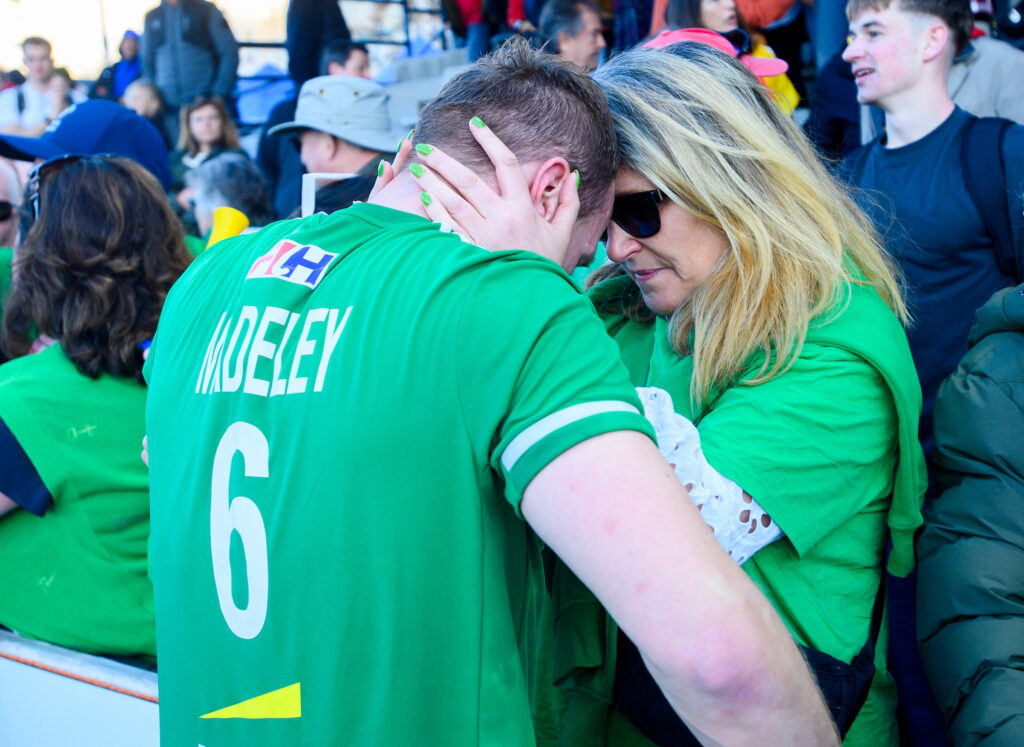
** Siobhán with her son Luke following Ireland’s Olympic qualification in Valencia in 2024. Picture: Frank Uijlenbroek/World Sport Pics
As EuroHockey Championships evolved—moving from a four-year cycle to the now-established two-year rhythm—she saw the event transform from modest tournaments into major occasions defined by professionalism and equal visibility for men’s and women’s hockey.
Delivering joint events of equal stature remains, she believes, one of hockey’s strongest selling points.
A philosophy of purpose
At the core of Siobhán’s career is a deep personal motivation: “I chose a career in sport because fundamentally I want to make a difference,” she reflects. “I believe in being humble enough to never stop learning.”
Through enhanced education of organisers, officials, and volunteers, she has championed the creation of “more professional events that are player and fan centric—a delicate balance but thoroughly satisfying when achieved.”
Driving EuroHockey’s communications— digitally and face-to-face through press operations —has been “an honour,” she says.
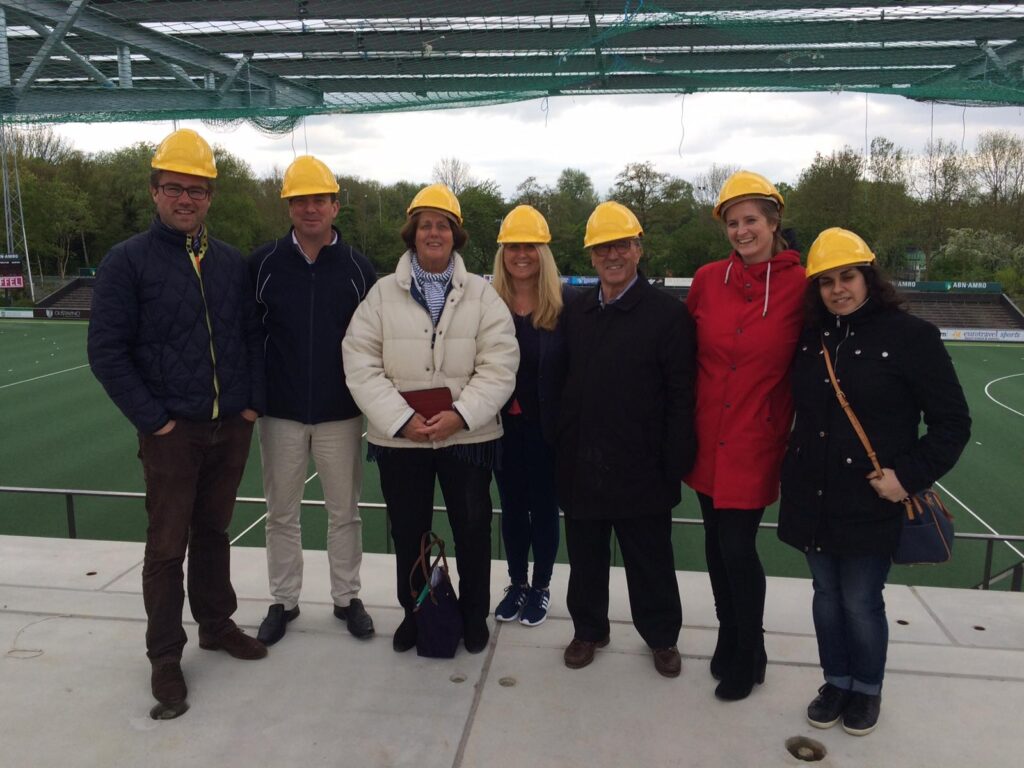
** Pictured during the construction of the new stand at the Wagener Stadium in Amstelveen
That sense of service extends beyond formal duties. Following her undignified retirement from playing due to injury, her founding of Ireland’s first Hockey ID team at Three Rock Rovers in 2019 sparked a nationwide movement toward inclusive hockey opportunities for people with intellectual disabilities—a contribution she counts among her proudest achievements.
A legacy of evolution
Three decades after accepting that unexpected invitation from David Balbirnie, Siobhán’s fingerprints are everywhere in EuroHockey’s modern identity: in its communications voice, its event presentation, its digital platforms, its evolving professionalism, and its human warmth.
She has been a constant through change—sometimes driving it, sometimes adapting to it, always embracing it. “Change is a constant in European hockey and probably one of the main reasons why I’ve stayed, apart from my love of the game.
We have been undeniably fortunate to be led through that change under the direction of (for me) five Presidents: Alain Danet, Martin Gotheridge, Leandro Negre, Marijke Fleuren, and current President Marcos Hofmann. Each with their own leadership approach, each making a mark to improve European hockey.
“Throughout my 30 years I have made friends and worked with colleagues who have supported me, celebrated with me, and often shared a precious beer at the end of a long day. Always ready to go again tomorrow!”
Thirty years on, EuroHockey stands stronger, more connected, more relevant—and immeasurably richer for her presence.


