

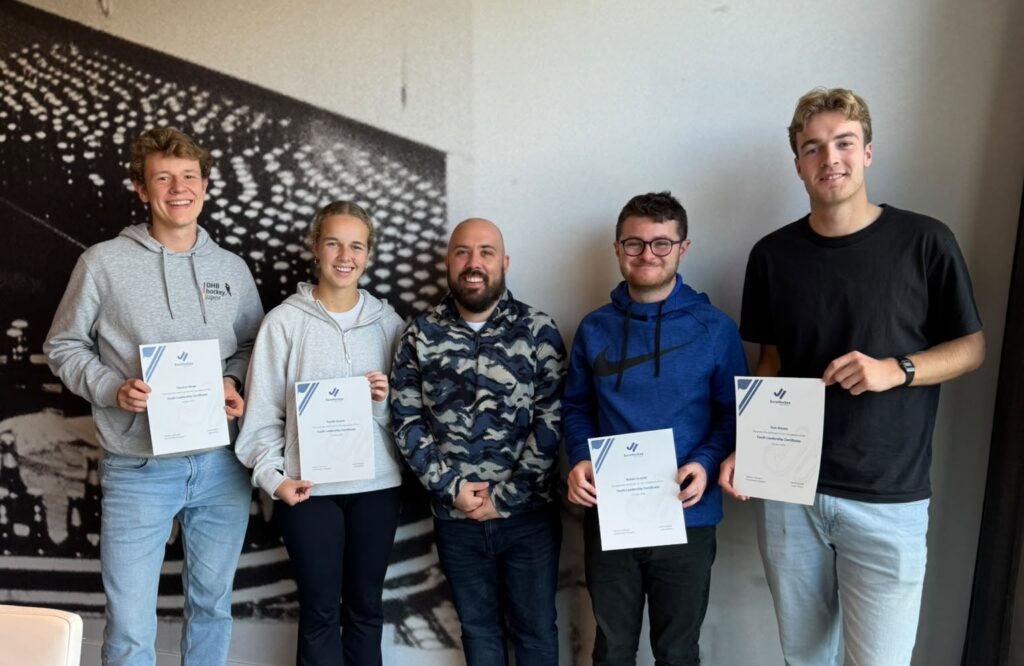
The second cohort of the EuroHockey Youth Leadership Certificate programme graduated last week in Eindhoven at EHL ROUND1 following an intensive year.
The programme is designed to help young people develop leadership skills while creating projects that make a difference in hockey with the group taking on initiatives ranging from media and participation projects to strengthening youth representation within national federations.
The group was guided through the course by Jamie Hooper with a number of guest experts overseeing a range of sessions.
For many of the participants, the certificate programme is a natural continuation of the friendships and inspiration formed at the EuroHockey Youth Leadership Festival in Mönchengladbach in 2025.
Belgium’s Mathieu Kransfeld said the experience had encouraged him to remain involved long after that first event.
“Most of us have been to the Youth Leadership Festival at the European Cup in Mönchengladbach in 2025,” he explained. “From there on, we had so much fun, I think I can speak for all of us, that we didn’t want to stop there.
“That’s why we went and did this new youth leadership story. It’s different, of course, because it’s more online and more throughout the year instead of a five-day, intensive thing. But to be here for a weekend and relive that in-person experience, it’s really nice and I really enjoy it.”
Kransfeld’s own project, Hockey Media Belgium, aims to shine a spotlight on hockey stories and developments within Belgium, providing a new independent platform for the sport.
For Ireland’s Caoilinn Dunne, the programme has helped shape and strengthen Perform Hockey Academy’s Girls in Sport initiative, creating opportunities for young girls to enjoy the sport in a supportive environment.
“Perform is about providing an environment that’s outside of school or club hockey,” she said. “It’s unpressurised and for any player. So you don’t have to be the best on your team to come and play. You can just be starting, just pick up a stick.
“I think we’ve levelled it in a way that if you’re brand new, you’re getting the coaching that supports you and have fun, of course. Then if you’ve been playing for ages, you can get better in an environment like that as well.”
Reflecting on the value of the Youth Leadership Certificate, Dunne added that it had helped participants better understand both themselves and their projects.
“At the start, when I came to the festival last year, we had just begun and run a summer camp. The festival was showing us what you could do by being a leader.
“Signing up to this certificate has helped develop our own project and ourself as a leader within that. It’s a real deep dive into what leadership skills you have and how you can apply that to whatever we’re all working on.
“You also see examples from people who have done similar things and how you can bring that into your work as well.”
Hendrik Ringe is using the programme to support his work in youth representation within the German Hockey Federation.
“I’m trying to strengthen youth representation in Germany,” he said. “I’m youth speaker of the German youth federation and I try to bring youth speakers and representatives into every state federation.
“I try to bring young people to the table when decisions are made and bring our youth structures a bit more young representation.”
For Ringe, one of the strengths of the programme is the new perspectives it offers.
“The course gives another angle on hockey,” he explained. “There are a lot more points of view which I can get from this course. It gives me a deeper dive into some topics which I just haven’t thought about before and things which are maybe more important than I thought before.”
Another Irish participant, Tom Simms, highlighted the access participants receive to experienced leaders within hockey and the opportunity to engage with them as equals.
“What I found really cool about the course is how much access it’s given me to various people that you think are ‘hard-to-reach’,” Simms said. “When you come to the course, they treat you like equals and you’re just chatting with them.
“That’s very cool. You realise the stuff they’re doing, they’re humans too. They didn’t come down and tell us what to do or how to do things. They got really involved with the conversation with us. It’s an interesting dynamic.”
The programme’s impact is also being felt beyond traditional leadership roles. Rob Crosse from Wakefield in Egland plays for the England Intellectual Disability Team and is using the course to support his project, This Coach Can, which aims to encourage more opportunities for people with disabilities within coaching.
“So it’s basically about people with disabilities getting coached and getting the opportunity,” he said. “It shows people that people can be a leader.”
He was initially inspired by the London 2012 Olympic Games, “the fastest game” he had ever seen and sought out where he could play the sport.
Since then, he has travelled far and wide with hockey and is now looking to build his coaching expertise in the Hockey ID realm.
“As well as coaching, one day I’ll be coaching. Who knows how old I’ll be then. I’ll just keep it up because I’ve loved every tournament so far and I keep getting better each time.”
The Eindhoven gathering offered a suitable closing celebration of the programme’s central purpose: empowering young people to turn ideas into action, support one another’s ambitions and help shape the future of hockey both on and off the pitch.
| First name: | Last name | NA: |
| Caoilin | Dunne | Ireland |
| Lauren | Wood | England |
| Linda | Nova | Czechia |
| Petra | Hrupec | Croatia |
| Tom | Simms | Ireland |
| Hendrik | Ringe | Germany |
| Mathieu | Kransfeld | Belgium |
| Robert | Crosse | England |
| Josip | Briški | Croatia |


